Trauma leaves lasting imprints on our lives, shaping how we see the world, others, and ourselves. The aftermath can feel overwhelming, as if we are left picking up the pieces of a life we no longer recognize. But within the wreckage, growth is possible.
Post-traumatic growth is the process by which survivors not only heal but transform, discovering new strengths, perspectives, and opportunities they may never have considered before. It is not about erasing pain, but about finding meaning beyond it—emerging from the shadows with a renewed sense of self.
The Hidden Strength Within Trauma
At first, survival is the only focus. The body and mind work to process the shock, the loss, the enormity of what has happened. But over time, survivors may notice something new stirring within them—a strength they never knew they had.
Resilience takes root. The realization dawns: I made it through. The challenges that once seemed insurmountable now serve as proof of inner strength.
Life feels more precious. Trauma often shifts our perspective, deepening our appreciation for what truly matters—love, presence, connection.
New doors open. What once felt limiting no longer holds power. Survivors may explore new paths, careers, hobbies, or passions.
Relationships evolve. Adversity fosters empathy and deeper connections, helping survivors build meaningful relationships rooted in authenticity and trust.
Spirituality shifts. Whether through faith, personal reflection, or connection with nature, many find themselves searching for—and often discovering—new meaning in life.
Yet, recognizing this growth is not always easy. Moving forward takes time, intention, and the right tools.
Steps Toward Growth After Trauma
Though each survivor’s path is unique, there are common ways to nurture personal growth in the wake of trauma.
Mindfulness and Breathwork – Practices like meditation, deep breathing, and yoga can help regulate emotions and bring awareness to the present moment.
Self-Compassion – Healing requires patience. Treating ourselves with the same kindness we would offer a loved one allows for deeper emotional recovery.
Creative Expression – Writing, painting, music, and other creative outlets provide ways to process emotions that words alone may not capture.
Nature and Grounding Practices – Spending time outdoors, walking barefoot on the earth, or simply feeling the warmth of the sun can be profoundly healing.
Therapeutic Support – Trauma-focused therapy, cognitive behavioral techniques, and body-based approaches like trauma-sensitive yoga help survivors process and move through pain.
Building Connection – Seeking support from trusted friends, family, or survivor communities can reduce isolation and provide validation.
Reframing the Narrative – Growth often comes from seeing trauma not as an ending but as a transformation—an opportunity to redefine priorities and reclaim personal power.
The Journey is Yours
Healing is not about returning to who we were before trauma. It is about becoming someone new—someone who carries their past with wisdom, not weight.
Post-traumatic growth does not mean we forget the darkness, nor does it mean we are grateful for the pain. But it does mean that in the process of healing, we can find strength, purpose, and the courage to emerge from the shadows—free, untethered, and fully alive.
Emerging from Trauma: The Power of Post-Traumatic Growth
Trauma leaves lasting imprints on our lives, shaping how we see the world, others, and ourselves. The aftermath can feel overwhelming, as if we are left picking up the pieces of a life we no longer recognize. But within the wreckage, growth is possible.
Post-traumatic growth is the process by which survivors not only heal but transform, discovering new strengths, perspectives, and opportunities they may never have considered before. It is not about erasing pain, but about finding meaning beyond it—emerging from the shadows with a renewed sense of self.
The Hidden Strength Within Trauma
At first, survival is the only focus. The body and mind work to process the shock, the loss, the enormity of what has happened. But over time, survivors may notice something new stirring within them—a strength they never knew they had.
Resilience takes root. The realization dawns: I made it through. The challenges that once seemed insurmountable now serve as proof of inner strength.
Life feels more precious. Trauma often shifts our perspective, deepening our appreciation for what truly matters—love, presence, connection.
New doors open. What once felt limiting no longer holds power. Survivors may explore new paths, careers, hobbies, or passions.
Relationships evolve. Adversity fosters empathy and deeper connections, helping survivors build meaningful relationships rooted in authenticity and trust.
Spirituality shifts. Whether through faith, personal reflection, or connection with nature, many find themselves searching for—and often discovering—new meaning in life.
Yet, recognizing this growth is not always easy. Moving forward takes time, intention, and the right tools.
Steps Toward Growth After Trauma
Though each survivor’s path is unique, there are common ways to nurture personal growth in the wake of trauma.
Mindfulness and Breathwork – Practices like meditation, deep breathing, and yoga can help regulate emotions and bring awareness to the present moment.
Self-Compassion – Healing requires patience. Treating ourselves with the same kindness we would offer a loved one allows for deeper emotional recovery.
Creative Expression – Writing, painting, music, and other creative outlets provide ways to process emotions that words alone may not capture.
Nature and Grounding Practices – Spending time outdoors, walking barefoot on the earth, or simply feeling the warmth of the sun can be profoundly healing.
Therapeutic Support – Trauma-focused therapy, cognitive behavioral techniques, and body-based approaches like trauma-sensitive yoga help survivors process and move through pain.
Building Connection – Seeking support from trusted friends, family, or survivor communities can reduce isolation and provide validation.
Reframing the Narrative – Growth often comes from seeing trauma not as an ending but as a transformation—an opportunity to redefine priorities and reclaim personal power.
The Journey is Yours
Healing is not about returning to who we were before trauma. It is about becoming someone new—someone who carries their past with wisdom, not weight.
Post-traumatic growth does not mean we forget the darkness, nor does it mean we are grateful for the pain. But it does mean that in the process of healing, we can find strength, purpose, and the courage to emerge from the shadows—free, untethered, and fully alive.
When I see women stepping away (decentering) from the patriarchy or millennials distancing themselves from their parents, I recognize the same thing happening: a powerful, quiet shift that says, “Please, treat me like a human. I’m done carrying the emotional weight for a connection when you won’t show up in ways that respect me.” It’s happening in romantic relationships, and it’s happening within families. One person is trying to dominate the other, and the other is saying, “No more.”
This shift is not just about distancing; it’s about reclaiming our right to be seen and respected as equals. It’s about recognizing that relationships, whether romantic or familial, must be built on mutual respect, not power struggles. If you want a real connection with me, there are no power dynamics at play. We show up with joy, a willingness to understand each other, and a shared love. Our feelings matter—whether we agree or disagree. No one gets to control another person’s time, space, or emotions.
I choose when I give access to myself, moment by moment. No one is entitled to it just because of who they are to me. This is the basic foundation for healthy, authentic relationships. But trauma makes these boundaries hard to honor. When we’re disconnected from ourselves—emotionally and physically—we can’t fully connect with others. And so, we resort to unhealthy ways of holding on—through loyalty or financial control, things that mask the real work of connection.
Healing begins when you reclaim your own identity. When you are honest with yourself, trust yourself, feel your emotions, and take care of yourself as an adult, you begin the process of building a personal foundation that is unshakeable.
The generations that came before us dealt with a lot of dysfunction, power struggles, and a loss of autonomy (especially for women). Abuse was accepted for women and children, at home, school, and the workplace. And one thing our world has never been in short supply of is war. Generations of men (and women) went to war, returned broken, and passed down their pain. That trauma lingers, shaping how we relate to one another.
It doesn’t take a massive event to cause trauma. In fact, trauma isn’t something that happens to you—it’s how your nervous system processes a traumatic event. Sometimes, it’s the smallest moments that leave the deepest marks, especially for children. But healing is possible, and it’s necessary. We are at a time where healing is essential to how we show up in our relationships. We can no longer build connections in the absence of boundaries. We have to heal to truly relate—and it starts with healing what was broken.
My Personal Insight: A Legacy of Healing
Raising my sons has been one of my greatest acts of healing. I’ve spent much of my life breaking free from the patterns I inherited from my parents—many of which they inherited from their own parents. My father, who I know loves me, is controlling and emotionally distant. My mother, though loving, has been subjugated to him my entire life. When I married at the age of 28, my partner brought his own history of intense trauma into our relationship, ultimately trying to control and diminish me.
I had to unlearn everything I was taught, not just for my own sake, but for my children as well.
I never wanted my sons to experience the same cycle of power and control that I did. I was determined to break the cycle and protect them from that. But healing is not something that happens overnight. It’s been an intense process, and I’ve learned that this journey of healing is just as much for them as it is for me.
My own healing only truly began after I escaped my abusive marriage. It has taken time—years, in fact—for me to identify the patterns of dysfunction I was caught in—and I’m still healing. I know that my trauma—the way I was raised and the relationships I’ve had—has shaped my responses and my approach to raising them. I don’t want our home to feel rigid or oppressive, so I’ve tried to create a space where they can heal themselves, without pressure or judgment. Even though I tried to protect them from the trauma I experienced, they still felt its echoes. Perhaps they wonder why I reacted in certain ways or why some patterns feel familiar. They too carry their own trauma—different from each other, stemming from their time with their abusive father. These wounds run deep within them, and only they can bring them into the light, where healing can begin.
In the absence of a father, my sons have gotten to know my father, their only grandfather, very well. A good man with many strengths, but he was raised in a time and in ways that didn’t allow him to be emotionally available or aware. The trauma he experienced carried over into his relationship with me, and in turn, it affected how I was able to show up for them at times. This legacy is real, and recognizing it is the first step to healing. Watching my mother become subservient to him and their religious dogma only deepened the dysfunction. This was her story, passed down from her mother: a man ruling over a woman—unhappy and unfulfilled—looking for escape or a better way. Even though I rejected and hated what I saw growing up, it still felt familiar when I met the man who would become my husband. That’s what happens with trauma—it feels like home, even when it’s unhealthy. It’s not a comfort, but a deep-seated familiarity that can be hard to shake, even when it’s harmful.
I understand that trauma can feel like a bond, even if it’s destructive, and it’s hard to break free from that. It is rooted in generations past and it lives in our very bones and flows in our blood. This is why it’s so important to see how dominance in relationships operates. It’s not always loud or violent, and it doesn’t always look like someone who is just too controlling or manipulative. We may interpret it as “care” or “concern,” but it’s really about control. Whether it’s a parent controlling who you see, where you go, who you worship, how you think, or a partner making you feel less than, it all comes from the same place: fear and control.
I’ve been a devoted student on my journey of healing, not just for me, but for them. I want my sons to know that they have the power to do the same. They are not bound by the patterns of the past. They are capable of building relationships based on love, equality, and understanding. They are worthy of all the love that comes from a place of respect—not control—and they must offer the same to others worthy of them. I can guide them, but the work of healing belongs to them alone. I’ll always be here to walk beside them, but the real journey is theirs to take.
A pivotal piece of writing that has helped guide my parenting, more than almost anything else, is by Khalil Gibran, On Children:
“Your children are not your children. They are the sons and daughters of Life’s longing for itself. They come through you but not from you, And though they are with you yet they belong not to you. You may give them your love but not your thoughts, For they have their own thoughts. You may house their bodies but not their souls, For their souls dwell in the house of tomorrow, which you cannot visit, not even in your dreams. You may strive to be like them, but seek not to make them like you. For life goes not backward nor tarries with yesterday. You are the bows from which your children as living arrows are sent forth. The archer sees the mark upon the path of the infinite, and He bends you with His might that His arrows may go swift and far. Let your bending in the archer’s hand be for gladness; For even as He loves the arrow that flies, so He loves also the bow that is stable.”
When they enter future relationships, I hope they do so with the wisdom of knowing that love is never about control. It’s about two people coming together with respect and shared growth.
Another piece by Gibran that has guided me in my own life is, On Marriage:
“…let there be spaces in your togetherness, And let the winds of the heavens dance between you. Love one another, but make not a bond of love: Let it rather be a moving sea between the shores of your souls. Fill each other’s cup but drink not from one cup. Give one another of your bread but eat not from the same loaf. Sing and dance together and be joyous, but let each one of you be alone, Even as the strings of a lute are alone though they quiver with the same music. Give your hearts, but not into each other’s keeping. For only the hand of Life can contain your hearts. And stand together yet not too near together: For the pillars of the temple stand apart, And the oak tree and the cypress grow not in each other’s shadow.”
Ultimately, as they heal, so too will the world around them. Their healing is not just for their own sake; it has the power to shift the very fabric of their relationships, their communities, and future generations. By doing the work to heal, they will light the path for others to follow. They have the power to change the course of their lives—and in doing so, help heal the world.
Born as Jalāl ad-Dīn Muhammad Balkhī Rūmī in 1207, in what is now Afghanistan, he was a 13th-century Persian poet, Islamic jurist, scholar, theologian, mystic, and Sufi master. Through his poetry, Rūmī expressed themes of divine love, compassion, and the soul’s journey back to the Divine.
“Stop acting so small. You are the entire universe in ecstatic motion.” “You were born with wings, why prefer to crawl through life?” “You are not a drop in the ocean, you are the entire ocean in a drop.”
Rūmī’s spiritual path was forever changed by his encounter with Shams of Tabriz, a mystic who opened him to profound spiritual depths and ignited his transformation. Through this meeting, Rūmī’s teachings began to center on love as the essence of all connections, the force binding us to each other and the sacredness within all life.
“We are born of love; Love is our mother.”
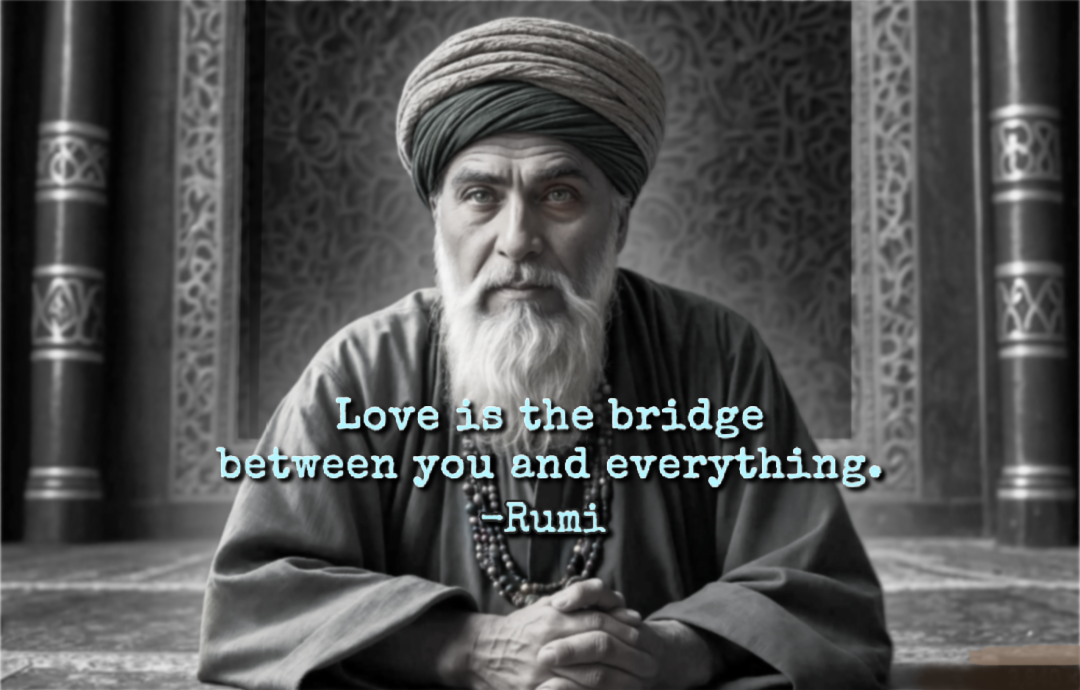
Rūmī’s message has endured across centuries, resonating with a universal yearning for connection that transcends cultural boundaries and beliefs. His words, “Love is the bridge between you and everything,”remind us that love is the thread uniting us to each other, to nature, and to the Divine.
“Do not feel lonely, the entire universe is inside you.”
In a world that feels more divided than ever, Rūmīs teachings are a timeless reminder of our interconnectedness. His wisdom speaks to us across boundaries, affirming that love dissolves separation, that we’re not adversaries but reflections of one another.
“I am neither of the East nor of the West, no boundaries exist within my breast.” “Raise your words, not your voice. It is rain that grows flowers, not thunder.”
As we witness uncomfortable shifts happening in the world, Rūmīs words remind me that love is not simply an emotion—it is a way of being that can transform and heal our world’s deepest wounds.
“The wound is the place where the Light enters you.”
His work urges us to rebuild bridges, to embrace love as a source of strength, to act from it and allow it to guide us forward. In these challenging times, his wisdom feels as vital as ever: a reminder that we carry the capacity for love and unity within us, waiting only to be awakened.
“Your task is not to seek for love, but merely to seek and find all the barriers within yourself that you have built against it.”
Rūmī’s legacy will remain a guiding light for all times, inviting all of us to transcend divisions, embody compassion, and discover the sacred connections that make us whole. What the world needs now is some discovery and digestion of the mystical wisdom from the Sufi poets.
When we begin to talk about trauma, it is important to understand that trauma isn’t what happens to you, but rather how your body and brain react to that experience. Not everyone responds the same way. Some people are more predisposed to developing post-traumatic stress
A traumatic event can cause your brain to get stuck in danger mode, even long after the threat is gone. It’s like your body is still on high alert, constantly sending out stress signals. This can lead to a dysregulated nervous system, making it hard to find peace and calm.
Trauma can leave a lasting imprint on our minds and bodies. When we experience a traumatic event, our brain switches into survival mode to protect us. This response is crucial in moments of real danger, but for many of us, our brains can get stuck in this high-alert state even after the danger has passed.
“Trauma can make it feel like you’re never safe, even if the world appears to be safe to everyone around you. This makes it incredibly difficult to explain to non-traumatized people, who can’t see the ‘reason’ why you feel anxious, scared, or powerless. Not all wounds are visible.” – Ella Hicks
What Happens to Your Brain? During trauma, the amygdala (the part of the brain responsible for detecting threats) becomes overactive, while the prefrontal cortex (responsible for rational thinking and decision-making) can become underactive. This imbalance means that even when you’re safe, your brain might still perceive threats, causing constant stress and anxiety.
The Impact on Your Body A dysregulated nervous system means your body is in a constant state of fight, flight, or freeze. This ongoing stress can lead to physical symptoms like headaches, muscle tension, digestive issues, and chronic fatigue. Emotionally, you might feel hypervigilant, irritable, or emotionally numb.
Healing and Regulation Healing from trauma involves teaching your brain and body that it’s safe again. Here are a few steps to start:
1. Grounding Techniques
Deep Breathing: Practicing deep, slow breaths can activate the parasympathetic nervous system, which helps to calm the body. Try inhaling for four counts, holding for four, and exhaling for four.
Mindfulness Meditation: Engage in mindfulness meditation to bring your focus to the present moment. Apps like Headspace or Calm can guide you through the process.
Grounding Exercises: Techniques like pressing your feet into the ground, holding a piece of ice, or focusing on your surroundings can help anchor you in the present moment.
2. Therapy and Support
EMDR (Eye Movement Desensitization and Reprocessing): This therapeutic approach helps process and integrate traumatic memories, reducing their emotional charge.
Somatic Experiencing: This method focuses on bodily sensations to release stored trauma and regulate the nervous system.
Cognitive-Behavioral Therapy (CBT): CBT helps reframe negative thought patterns and develop healthier coping mechanisms.
3. Self-Compassion
Gentle Self-Talk: Replace self-criticism with supportive and understanding self-talk. Recognize your progress and effort, regardless of the pace.
Mindful Self-Compassion: Practices such as loving-kindness meditation can help you develop a kinder relationship with yourself.
4. Healthy Lifestyle
Regular Exercise: Physical activity, especially aerobic exercises like walking, running, or dancing, can help regulate stress hormones and boost mood.
Balanced Diet: Eating a nutritious diet supports overall well-being and can help stabilize mood swings.
Sufficient Sleep: Prioritize sleep hygiene to ensure you get adequate rest, which is crucial for healing and emotional regulation.
Joyful Activities: Engage in hobbies and activities that bring you joy, whether it’s painting, reading, gardening, or spending time in nature.
5. Community
Supportive Relationships: Cultivate relationships with people who understand and support you. Sharing your experiences can foster connection and validation.
Support Groups: Join support groups, either in-person or online, where you can share your journey with others who have similar experiences.
Rebel Thriver Community: In the Rebel Thriver Village, a private online community for women survivors of DV, abuse, and trauma, we provide a safe space for sharing and support. Connect with us and other members who are on a similar path to healing.
“Trauma isn’t just the bad stuff that happened. It’s also the good stuff that never happened.” – Dr. Heidi Green
Remember, You Are Not Alone
When I first began my healing journey, I was overwhelmed and completely isolated. I struggled with constant anxiety and physical symptoms that seemed unexplainable. I had no point of reference for domestic violence; I didn’t think I knew anyone who had experienced it…little did I know then what I know now.
Eventually, I was diagnosed with CPTSD, Complex Post Traumatic Stress (disorder). There wasn’t much talk about trauma back then, so I started reading everything I could find in order to help myself and my children. I learned grounding techniques, embraced self-compassion, and slowly started to reclaim my sense of safety. I took classes and joined webinars, ultimately leading me to get my certification as a Clinical Trauma Professional and as a Mindfulness Coach.
In 2012, I created this blog in the hope of meeting other women who shared my experiences. I reached my trembling hand out into the darkness, and thousands of women from around the world reached back. Rebel Thriver quickly grew into a beautiful global community of people who understood each other’s lived experiences. This makes all the difference.
If you’re feeling stuck, remember that seeking help is a sign of strength, not weakness. Rebel Thriver is here to support and uplift women every step of the way. Together, we can find peace and reclaim our sense of safety and well-being.
Much Love, Ella xx
If you are interested in working with Ellaas a private client:Individual Sessions
If you are interested in joining one of Ella’s popular group coaching experiencesfor women: BLOOM or Wildflowers
If you are interested in joining our private online community, the Village, you can join us here: rebelthrivertribe.com
In the realm of Amazon Prime’s extensive library, there’s a hidden gem that recently caught my attention: “The Lost Flowers of Alice Hart.” Highly recommended by my friend Heather, I embarked on this journey, not fully prepared for the emotions it would stir within me. As I sat through its episodes, I found myself very triggered, and I felt a strong urge to share my thoughts and experiences with all of you.
When my friend initially asked if I had seen this series, I responded with a “no,” but with a promise to check it out. Her emphatic endorsement made it clear that this was a must-watch. I opened up Amazon Prime, and to my surprise, I discovered that the show had been partially viewed, halfway through the first episode. I thought that perhaps my son’s girlfriend had started it, so I decided to begin from the very beginning.
As the story unfolded, I couldn’t help but notice some eerie familiarity, which I initially attributed to a trailer or an advertisement I might have glimpsed earlier. I persisted with my viewing. When I reached the halfway point, a profound realization struck me – I had watched this episode before. I had watched until the midway mark and then abruptly turned it off. The reason was simple: it had triggered me to such an extent that I had buried the memory deep within my psyche. This is the insidious nature of trauma; it can hide within us, resurfacing unexpectedly.
This time, I pushed through the initial discomfort and watched the entire first episode. Last night, I completed all seven episodes. It was emotionally challenging at times, but I persevered because I understood why my friend had recommended it so strongly. It was a necessary watch. “The Lost Flowers of Alice Hart” mirrors my life and the mission of Rebel Thriver in countless ways. To avoid spoilers, I won’t delve into the storyline any further.
Connection is vital for survivors on a path of healing. Sharing the stories of survivors and listening to their voices is essential. Healing cannot thrive in isolation; we require spaces where we can come together and simply be. I am grateful to Amazon Prime for featuring this profoundly realistic production. It tells a version of our stories that educates people and validates the experiences of survivors worldwide, even though it originates from Australia.
I wholeheartedly encourage all the women you know to watch this Prime show. Sigourney Weaver’s portrayal in the lead role is nothing short of incredible, and she is supported by a cast of complex and dynamic female characters. Ultimately, at its core, the series conveys a message of healing and resilience, leaving a powerful impact.
I know it may be hard to watch, but I encourage you to try. Share this with your friends and consider having a watch party with it. Like trauma, this story has layers that need to be unpacked. There are patterns of generational abuse and dysfunction, and this is a place where we can see the big picture laid out. It’s like an archeological dig…little by little you begin to unearth the truth.
Ella xx
“And her light stretches over salt sea equally and flowerdeep fields.” -Sappho