“I have done nothing all summer but to wait for myself to be myself again.” — Georgia O’Keeffe
As this season draws to a close, I find myself reflecting on the power of waiting. I think about how healing often unfolds in silence. It happens in slowness and unseen places. What follows is not an explanation or a roadmap, but a prayer I needed to write for myself.
I. The Courage to Wait
There is a wisdom in waiting that our culture does not honor. We live in a world obsessed with productivity, speed, and achievement. Rest is mistaken for laziness, and silence is confused with absence.
All summer, I waited. For the quiet to soften me. For the storms inside to pass. For the woman I lost along the way to rise and meet me again.
And she is coming— slowly, fiercely, wholly— like a wildflower breaking through stone, like the horizon pulling light back into itself.
This is what healing often asks of us: to trust the invisible underground work, and the gestation that can’t be hurried. Seeds must split in the dark before they bloom in the light. Similarly, we must surrender to seasons of waiting. Only then can we rise whole again.
II. The Feminine Rhythm
In the feminine soul, healing does not move in straight lines. It circles and spirals. It withdraws before it returns. It rests before it creates.
This rhythm is not weakness—it is ancient wisdom. The body knows how to heal. The spirit knows how to return. Our task is not to force it, but to allow it. To trust that our becoming is not delayed; it is ripening.
III. The Dawn Always Comes
We don’t always heal by doing more. Sometimes we heal by waiting. By letting silence do its work. By trusting that the parts of us we thought were gone are only gathering strength to return.
If you’ve been waiting for yourself, know this: she is still here. She is still coming back.
And when she rises, it will be with roots deeper, branches stronger, and a light no storm can take away.
When I first heard the title, Dying for Sex (Hulu), I assumed I knew what I was walking into. Something provocative. Maybe irreverent. At best, an exploration of pleasure at the edge of mortality. But what I found was something far more sacred—a story of childhood sexual abuse, disconnection from the body, friendship that becomes a lifeline, and one woman’s wild, awkward, holy attempt to reclaim herself before the clock ran out.
This isn’t a story about sex. It’s a story about survival, intimacy, friendship, and the long, complicated journey of coming home to yourself.
I didn’t expect to be gutted by a show called Dying for Sex, but I was. The truth is, it wasn’t about sex. Not really. “Molly’s” story is one woman’s true story about living—and dying—with cancer.
Molly’s breast cancer had gone into remission, but ultimately, it returned. It had spread to her bones, liver, and brain. Stage IV. Terminal. She had been married for 13 years at this point. Her husband loved her, but had begun to see her only through the lens of a caretaker. He couldn’t fully see the woman she still was—a woman who craved not just safety, but desire. So she left him.
What she longed for was true embodiment in the presence of another. To be met without flinching. Without pity. Without being reduced to her illness or her past. Her treatment regimen had an unexpected side effect: it drastically increased her libido. But she wasn’t dying for sex—she was dying for safety, for intimacy, for a chance to feel something she’d been denied her whole life: real connection, acceptance, and love.
One of the main threads running through her story is the abuse she endured at age seven by her mother’s boyfriend. The wounds of sexual abuse don’t just fade—they shape-shift. Into shame. Into silence. Into a lifelong negotiation between your mind, your body, and your self-worth.
That guilt is heavy. And Molly carried it. Survivors know it well—the lie that you “participated.” That you could’ve stopped it. That your body’s response made you complicit. It’s a wound that defies logic. It damages not only your relationship with yourself, but also with the people you love—like her mother.
Molly’s story isn’t just bold—it’s legendary. She didn’t heal in the traditional sense. She didn’t transcend her pain. But she made room for herself inside it. For survivors like me—and like so many of us—that kind of reclamation is holy. Because in the middle of breaking down, she broke open. And in the shadow of death, she was reborn.
What makes her story even more powerful is her willingness to keep reaching across the divide. In time, she made peace—not just with her past, but with her mother. Not through a grand reconciliation, but through a series of quiet understandings. As she forgave herself, space opened to see her mother not only as someone who failed her, but as a woman shaped by her own silences and fears.
Forgiveness didn’t mean forgetting. It meant loosening pain’s grip. Releasing the knot in her chest so she could breathe again. Love again. Live out what was left of her life in peace.
Molly’s healing wasn’t about sex. It was about finding herself in the wreckage of a childhood where her body became a battleground and trust became collateral damage.
I know the stranglehold of that trauma personally. It doesn’t just haunt your memories—it hijacks your body, your sense of self, your relationships. Decades later, it can show up in the most intimate places where trust should live, but fear has built its home.
Through all of this—her unraveling, her ache, her awkward fumbling toward connection—there was Nikki. Her best friend and anchor. The mirror without judgment. The witness who didn’t try to fix her. When Molly asked, “Can I die with you?” I wept. That’s the power of sisterhood.
True sisterhood is sacred. It says: You don’t have to do this alone. I’ve got you—through the dying of old selves, old beliefs, and lifelong shame. That kind of friendship is church. It’s resurrection. It’s medicine.
Nikki didn’t just show up—she stayed. Through the awkwardness. The unraveling. The raw truths. She bore witness. She didn’t flinch. She didn’t rush. She held space, even when it felt impossible.
That’s what sisterhood looks like. Not performance, but presence. A hand held while you fall apart. A mirror that reminds you who you are when you can’t see clearly.
Molly’s bravery was hers. But Nikki’s presence made it possible. That kind of unwavering friendship doesn’t just support healing—it is healing. In a world where survivors are often invisible, to be truly seen by another woman—without judgment, without shame—is a lifeline. A return to self.
Molly’s story isn’t tidy. It’s raw and at times absurd—just like life. Healing is rarely elegant, and that’s the beauty of this story. Molly didn’t wait to be polished. She stepped toward truth—messy as it was—and made it hers.
For those of us haunted by our past, disconnected from our bodies, desperate to come home to ourselves, Dying for Sex is more than a story. It’s a map. Not a perfect one. But a courageous, deeply human one. At its heart? A woman who dared to return to herself before her body gave out.
And she didn’t return to emptiness. She returned to wholeness. In the end, Molly found what she was searching for: love, safety, and a real, embodied connection—with herself, and with someone else.
Healing didn’t erase the past. But it opened a door to a future she never believed she could touch.
Not perfect. Not painless. But real. And all hers.
May we all be that brave. May we all have a Nikki.
For so many of us—especially those whose bodies were never safe places to live—healing is not linear. It’s messy. And sometimes, life gives you a deadline.
Dying for Sex reminds us that it’s never too late. To reach for yourself. To speak the truth. To be witnessed in your rawest humanity.
Even in the unraveling—you are worthy. Of love. Of friendship. Of being held.
Coming home to yourself, no matter how long it takes, is the bravest journey of all.
Mother’s Day can be tender ground. For some, it is a celebration. For others, a reminder of what was lost, what never was, or what could never be.
But before we were daughters, we were souls carried in the wombs of women who carried the stories of those who came before them. Even if the relationship has frayed or been severed, the roots still run deep.
We come from a lineage of grandmothers and great-grandmothers we may never know — women whose names we do not speak but whose stories echo in our bones. They are the unseen threads that tether us to something greater, to the sacred and the ancient.
Today, let us honor the first home we ever knew. Let us honor the women who carried us, whether in love, in pain, or in silence. And let us honor the unseen mothers in our lineage who left us legacies that may never be spoken but are felt in the marrow of our being.
Happy Mother’s Day to every woman — to those who birthed, to those who raised, to those who mother in their own ways.
You are seen. You are loved. You are part of a vast, unbroken chain.
When I see women stepping away (decentering) from the patriarchy or millennials distancing themselves from their parents, I recognize the same thing happening: a powerful, quiet shift that says, “Please, treat me like a human. I’m done carrying the emotional weight for a connection when you won’t show up in ways that respect me.” It’s happening in romantic relationships, and it’s happening within families. One person is trying to dominate the other, and the other is saying, “No more.”
This shift is not just about distancing; it’s about reclaiming our right to be seen and respected as equals. It’s about recognizing that relationships, whether romantic or familial, must be built on mutual respect, not power struggles. If you want a real connection with me, there are no power dynamics at play. We show up with joy, a willingness to understand each other, and a shared love. Our feelings matter—whether we agree or disagree. No one gets to control another person’s time, space, or emotions.
I choose when I give access to myself, moment by moment. No one is entitled to it just because of who they are to me. This is the basic foundation for healthy, authentic relationships. But trauma makes these boundaries hard to honor. When we’re disconnected from ourselves—emotionally and physically—we can’t fully connect with others. And so, we resort to unhealthy ways of holding on—through loyalty or financial control, things that mask the real work of connection.
Healing begins when you reclaim your own identity. When you are honest with yourself, trust yourself, feel your emotions, and take care of yourself as an adult, you begin the process of building a personal foundation that is unshakeable.
The generations that came before us dealt with a lot of dysfunction, power struggles, and a loss of autonomy (especially for women). Abuse was accepted for women and children, at home, school, and the workplace. And one thing our world has never been in short supply of is war. Generations of men (and women) went to war, returned broken, and passed down their pain. That trauma lingers, shaping how we relate to one another.
It doesn’t take a massive event to cause trauma. In fact, trauma isn’t something that happens to you—it’s how your nervous system processes a traumatic event. Sometimes, it’s the smallest moments that leave the deepest marks, especially for children. But healing is possible, and it’s necessary. We are at a time where healing is essential to how we show up in our relationships. We can no longer build connections in the absence of boundaries. We have to heal to truly relate—and it starts with healing what was broken.
My Personal Insight: A Legacy of Healing
Raising my sons has been one of my greatest acts of healing. I’ve spent much of my life breaking free from the patterns I inherited from my parents—many of which they inherited from their own parents. My father, who I know loves me, is controlling and emotionally distant. My mother, though loving, has been subjugated to him my entire life. When I married at the age of 28, my partner brought his own history of intense trauma into our relationship, ultimately trying to control and diminish me.
I had to unlearn everything I was taught, not just for my own sake, but for my children as well.
I never wanted my sons to experience the same cycle of power and control that I did. I was determined to break the cycle and protect them from that. But healing is not something that happens overnight. It’s been an intense process, and I’ve learned that this journey of healing is just as much for them as it is for me.
My own healing only truly began after I escaped my abusive marriage. It has taken time—years, in fact—for me to identify the patterns of dysfunction I was caught in—and I’m still healing. I know that my trauma—the way I was raised and the relationships I’ve had—has shaped my responses and my approach to raising them. I don’t want our home to feel rigid or oppressive, so I’ve tried to create a space where they can heal themselves, without pressure or judgment. Even though I tried to protect them from the trauma I experienced, they still felt its echoes. Perhaps they wonder why I reacted in certain ways or why some patterns feel familiar. They too carry their own trauma—different from each other, stemming from their time with their abusive father. These wounds run deep within them, and only they can bring them into the light, where healing can begin.
In the absence of a father, my sons have gotten to know my father, their only grandfather, very well. A good man with many strengths, but he was raised in a time and in ways that didn’t allow him to be emotionally available or aware. The trauma he experienced carried over into his relationship with me, and in turn, it affected how I was able to show up for them at times. This legacy is real, and recognizing it is the first step to healing. Watching my mother become subservient to him and their religious dogma only deepened the dysfunction. This was her story, passed down from her mother: a man ruling over a woman—unhappy and unfulfilled—looking for escape or a better way. Even though I rejected and hated what I saw growing up, it still felt familiar when I met the man who would become my husband. That’s what happens with trauma—it feels like home, even when it’s unhealthy. It’s not a comfort, but a deep-seated familiarity that can be hard to shake, even when it’s harmful.
I understand that trauma can feel like a bond, even if it’s destructive, and it’s hard to break free from that. It is rooted in generations past and it lives in our very bones and flows in our blood. This is why it’s so important to see how dominance in relationships operates. It’s not always loud or violent, and it doesn’t always look like someone who is just too controlling or manipulative. We may interpret it as “care” or “concern,” but it’s really about control. Whether it’s a parent controlling who you see, where you go, who you worship, how you think, or a partner making you feel less than, it all comes from the same place: fear and control.
I’ve been a devoted student on my journey of healing, not just for me, but for them. I want my sons to know that they have the power to do the same. They are not bound by the patterns of the past. They are capable of building relationships based on love, equality, and understanding. They are worthy of all the love that comes from a place of respect—not control—and they must offer the same to others worthy of them. I can guide them, but the work of healing belongs to them alone. I’ll always be here to walk beside them, but the real journey is theirs to take.
A pivotal piece of writing that has helped guide my parenting, more than almost anything else, is by Khalil Gibran, On Children:
“Your children are not your children. They are the sons and daughters of Life’s longing for itself. They come through you but not from you, And though they are with you yet they belong not to you. You may give them your love but not your thoughts, For they have their own thoughts. You may house their bodies but not their souls, For their souls dwell in the house of tomorrow, which you cannot visit, not even in your dreams. You may strive to be like them, but seek not to make them like you. For life goes not backward nor tarries with yesterday. You are the bows from which your children as living arrows are sent forth. The archer sees the mark upon the path of the infinite, and He bends you with His might that His arrows may go swift and far. Let your bending in the archer’s hand be for gladness; For even as He loves the arrow that flies, so He loves also the bow that is stable.”
When they enter future relationships, I hope they do so with the wisdom of knowing that love is never about control. It’s about two people coming together with respect and shared growth.
Another piece by Gibran that has guided me in my own life is, On Marriage:
“…let there be spaces in your togetherness, And let the winds of the heavens dance between you. Love one another, but make not a bond of love: Let it rather be a moving sea between the shores of your souls. Fill each other’s cup but drink not from one cup. Give one another of your bread but eat not from the same loaf. Sing and dance together and be joyous, but let each one of you be alone, Even as the strings of a lute are alone though they quiver with the same music. Give your hearts, but not into each other’s keeping. For only the hand of Life can contain your hearts. And stand together yet not too near together: For the pillars of the temple stand apart, And the oak tree and the cypress grow not in each other’s shadow.”
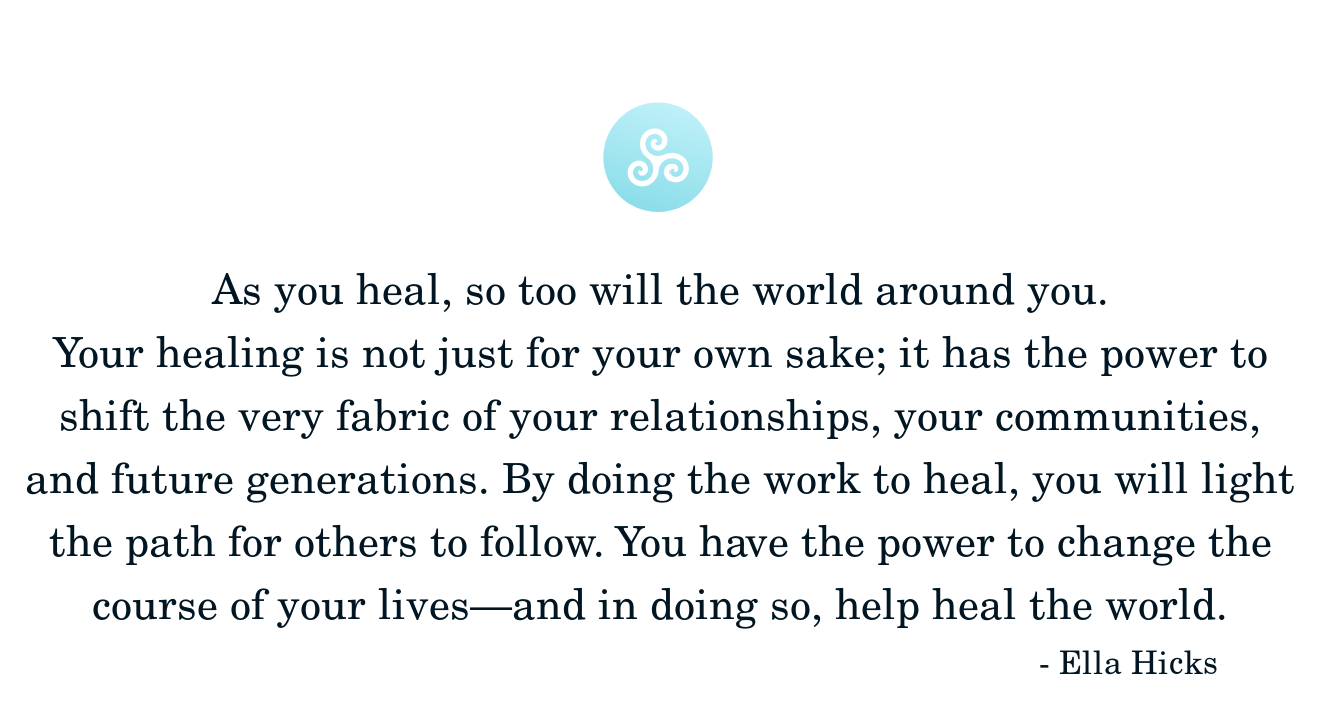
Ultimately, as they heal, so too will the world around them. Their healing is not just for their own sake; it has the power to shift the very fabric of their relationships, their communities, and future generations. By doing the work to heal, they will light the path for others to follow. They have the power to change the course of their lives—and in doing so, help heal the world.
Born as Jalāl ad-Dīn Muhammad Balkhī Rūmī in 1207, in what is now Afghanistan, he was a 13th-century Persian poet, Islamic jurist, scholar, theologian, mystic, and Sufi master. Through his poetry, Rūmī expressed themes of divine love, compassion, and the soul’s journey back to the Divine.
“Stop acting so small. You are the entire universe in ecstatic motion.” “You were born with wings, why prefer to crawl through life?” “You are not a drop in the ocean, you are the entire ocean in a drop.”
Rūmī’s spiritual path was forever changed by his encounter with Shams of Tabriz, a mystic who opened him to profound spiritual depths and ignited his transformation. Through this meeting, Rūmī’s teachings began to center on love as the essence of all connections, the force binding us to each other and the sacredness within all life.
“We are born of love; Love is our mother.”
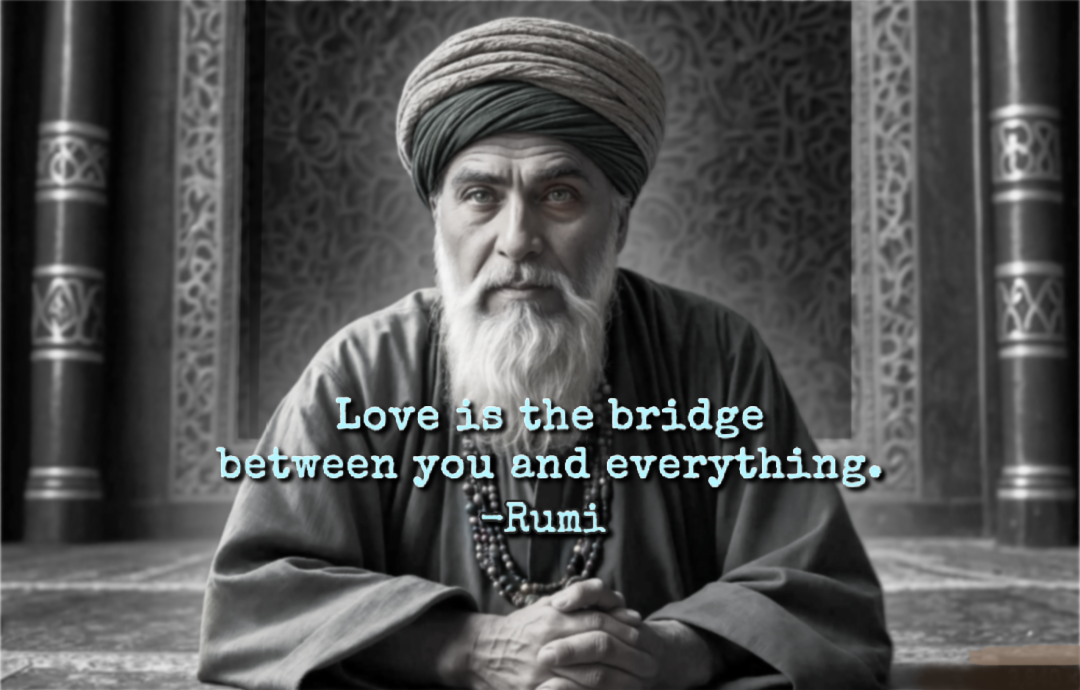
Rūmī’s message has endured across centuries, resonating with a universal yearning for connection that transcends cultural boundaries and beliefs. His words, “Love is the bridge between you and everything,”remind us that love is the thread uniting us to each other, to nature, and to the Divine.
“Do not feel lonely, the entire universe is inside you.”
In a world that feels more divided than ever, Rūmīs teachings are a timeless reminder of our interconnectedness. His wisdom speaks to us across boundaries, affirming that love dissolves separation, that we’re not adversaries but reflections of one another.
“I am neither of the East nor of the West, no boundaries exist within my breast.” “Raise your words, not your voice. It is rain that grows flowers, not thunder.”
As we witness uncomfortable shifts happening in the world, Rūmīs words remind me that love is not simply an emotion—it is a way of being that can transform and heal our world’s deepest wounds.
“The wound is the place where the Light enters you.”
His work urges us to rebuild bridges, to embrace love as a source of strength, to act from it and allow it to guide us forward. In these challenging times, his wisdom feels as vital as ever: a reminder that we carry the capacity for love and unity within us, waiting only to be awakened.
“Your task is not to seek for love, but merely to seek and find all the barriers within yourself that you have built against it.”
Rūmī’s legacy will remain a guiding light for all times, inviting all of us to transcend divisions, embody compassion, and discover the sacred connections that make us whole. What the world needs now is some discovery and digestion of the mystical wisdom from the Sufi poets.